Historic Cumbria: Off the Beaten Track by Pipe Beth & Pipe Steve
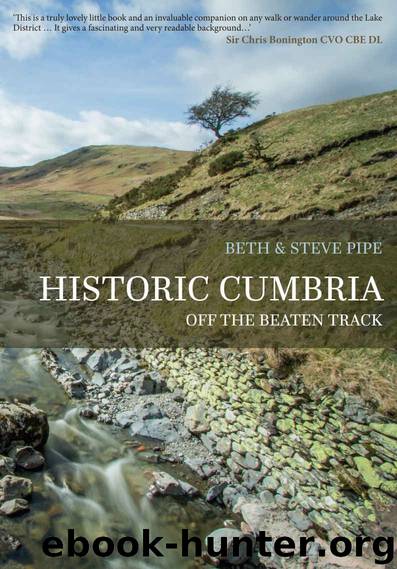
Author:Pipe, Beth & Pipe, Steve [Pipe, Beth]
Language: eng
Format: epub
Publisher: Amberley Publishing
Published: 2015-11-15T16:00:00+00:00
The old Celtic Bridges.
Pillbox near Dunmail Raise.
6
Kentmere and Longsleddale
These adjacent valleys just to the north of Kendal offer a language course in ancient Norse with their variety of place names. Both of them lie along ancient transportation routes connecting remote valleys within the Lakeland fells (the word ‘fell’ comes from the Old Norse fjall meaning ‘mountain’) and both have a rich history stretching from the Stone Age to modern day children’s television.
Natural History
The oldest rocks here are the ancient sediments laid down 455 million years ago and known as the Skiddaw Group. On top of these is an unconformity, which means there is a gap in age between the rocks on the bottom and the ones immediately above. In this case the ones on the top are the Borrowdale Volcanic series from 10 million years later and which dominate most of the central fells. The Skiddaw Group were laid down when this part of the country was languishing somewhere around the equator and the fine sediments deposited as shales and mudstones were turned into slate as they were heated and deformed by the volcanic activity; it’s those slates which explain many of the quarries along the Kentmere valley.
Once the rocks were in place it was time for the glaciers to do their work, leaving behind evidence which is familiar across much of Cumbria. The glaciers also left behind Kentmere Tarn, at first glance a fine example of a ribbon lake, but actually a lot more besides.
Sometime during the 1840s (nobody can pin down exactly when) the lake was drained to create additional farming land. This didn’t quite work out as planned because the land it left exposed was too swampy and acidic to be of much use to the farmers, but what it did expose was a rich source of diatomite. Diatomite is formed in crystal-clear glacial lakes when the bodies of millions of diatoms (single-celled algae made of silica) die and fall to the lake bed. A detailed study of the area identified ninety different species of diatom laid down during four or five different phases, indicating the glaciers advanced and retreated several times.
The diatomite was extracted during the first half of the twentieth century for use in the asbestos industry with later extraction methods radically altering the shape of the north end of the tarn, creating the large bulbous spur on the north-east edge. These days Kentmere Tarn is full of water again and stocked as a fishery.
At the entrance to Kentmere Valley is Dorothy Farrer’s Spring Wood, currently managed by Cumbria Wildlife Trust but in the past it was an important part of the local woodland industry. There is evidence of coppicing for bobbins, swill baskets (woven baskets made from thin strips of boiled oak) were made here and five charcoal burning sites can be easily identified on the reserve. The very best time to visit is in the spring when the entire woodland floor comes alive with wild garlic and bluebells.
Download
This site does not store any files on its server. We only index and link to content provided by other sites. Please contact the content providers to delete copyright contents if any and email us, we'll remove relevant links or contents immediately.
| Africa | Americas |
| Arctic & Antarctica | Asia |
| Australia & Oceania | Europe |
| Middle East | Russia |
| United States | World |
| Ancient Civilizations | Military |
| Historical Study & Educational Resources |
Room 212 by Kate Stewart(5119)
The Crown by Robert Lacey(4814)
Endurance: Shackleton's Incredible Voyage by Alfred Lansing(4780)
The Iron Duke by The Iron Duke(4354)
The Rape of Nanking by Iris Chang(4211)
Joan of Arc by Mary Gordon(4109)
Killing England by Bill O'Reilly(4001)
Say Nothing by Patrick Radden Keefe(3983)
I'll Give You the Sun by Jandy Nelson(3445)
Shadow of Night by Deborah Harkness(3367)
Hitler's Monsters by Eric Kurlander(3341)
Mary, Queen of Scots, and the Murder of Lord Darnley by Alison Weir(3210)
Blood and Sand by Alex Von Tunzelmann(3203)
Eleanor & Park by Rainbow Rowell(3170)
Darkest Hour by Anthony McCarten(3129)
Margaret Thatcher: The Autobiography by Thatcher Margaret(3081)
Book of Life by Deborah Harkness(2938)
Red Famine: Stalin's War on Ukraine by Anne Applebaum(2932)
The One Memory of Flora Banks by Emily Barr(2863)
